



“I cannot recommend the services of Robin Somerville enough. … What seemed like a complicated and daunting legal procedure was made stress-free … and he ensured a conclusion was reached much quicker than I would have thought. … Without doubt, the best money I have ever spent.”
Stephanie Bryan, Company Director
I can advise and act in a similar way to any other commercial lawyer, commercial solicitor, company solicitor or company lawyer. If you wish to instruct me, you can do so directly under the public access scheme or via a solicitor.
If you are a minority shareholder in a private company and you are being excluded from management, denied information, having company funds misused against your interests, or being frozen out by the majority, you may feel that you have no real power to do anything about it. In many cases, however, the law gives you significant remedies.
Section 994 of the Companies Act 2006 allows minority shareholders to bring an unfair prejudice petition against those in control of a company where the company’s affairs are being conducted in a way that is unfairly prejudicial to their interests. This is one of the most important and widely used remedies in company law, and it can result in a court-ordered buyout of your shares at a fair value, among other remedies.
Where directors have breached their duties and caused loss to the company, a derivative action may allow a shareholder to bring a claim on behalf of the company itself to recover that loss, even where the board refuses to act.
This page provides an overview of both remedies and links to more detailed guidance on each aspect. If you would like advice on your specific situation, I act as a direct access barrister specialising in shareholder disputes and can be instructed without a solicitor in appropriate cases.
An unfair prejudice petition is a claim brought by a shareholder under section 994 of the Companies Act 2006. It allows a shareholder to ask the court to intervene where the affairs of the company are being or have been conducted in a manner that is unfairly prejudicial to the interests of some or all of the members, including the petitioner.
The remedy is most commonly used by minority shareholders who are being excluded from management, denied a share of profits, or subjected to conduct by the majority that falls short of the standards they are legitimately entitled to expect. It is particularly powerful in quasi-partnerships, where the court applies higher standards of fair dealing between shareholders who have a relationship based on mutual trust and confidence.
The most common remedy in a successful unfair prejudice petition is a court order requiring the majority to buy out the petitioner’s shares at a fair value, often without any minority discount. That can make an unfair prejudice petition an extremely effective tool for a minority shareholder who wants to exit a company on fair terms but is being prevented from doing so.
For a detailed introduction to how unfair prejudice petitions work, see How can I claim an unfair prejudice petition under section 994 of the Companies Act 2006?
Not every disagreement between shareholders gives rise to an unfair prejudice claim. The conduct complained of must be both prejudicial to the petitioner’s interests as a member and unfair in the context of the relationship between the shareholders and the reasonable expectations that relationship gives rise to.
Common examples of conduct that has been found to amount to unfair prejudice include exclusion from management in a quasi-partnership company, excessive or unauthorised remuneration paid to directors, misuse or misappropriation of company funds, diversion of business opportunities away from the company, failure to pay dividends without justification, dilution of the petitioner’s shareholding, breach of the shareholders’ agreement, and denial of access to company information.
Understanding whether the conduct in your case crosses the legal threshold requires careful analysis of both the facts and the legal framework. For more detail on each element:
If an unfair prejudice petition succeeds, the court has a wide discretion to grant whatever remedy it considers fit. In practice the most common remedy is an order that the majority shareholders purchase the petitioner’s shares at a price determined by the court, usually on the basis of a pro-rata valuation of the company without any discount for the minority nature of the holding.
Other remedies the court can grant include an order regulating the future conduct of the company’s affairs, an order requiring the company to take or refrain from taking a particular action, and in appropriate cases an order for the winding up of the company. The court can also make orders relating to the conduct of litigation and costs.
The choice of remedy, and how to frame the petition to maximise the prospect of achieving the outcome you actually want, requires careful strategic thinking from the outset. For more detail see What are the remedies for a successful unfair prejudice claim?
A derivative action is a different kind of claim. Rather than a shareholder asserting their own rights as a member, a derivative action allows a shareholder to bring a claim on behalf of the company itself, typically where directors have breached their duties and caused loss to the company and the board is unwilling or unable to act to recover that loss.
Derivative actions are governed by sections 260 to 264 of the Companies Act 2006. They require the court’s permission to proceed, which means the shareholder must first satisfy the court that the claim has a prima facie case and that it is appropriate for it to continue. This is a significant procedural hurdle and strategic advice at an early stage is particularly important.
The types of director conduct that may give rise to a derivative action include breach of fiduciary duty, breach of the duty to act in the company’s interests, misappropriation of company assets, and acting in conflict of interest situations. For more detail see How do I bring a derivative claim under section 260 of the Companies Act 2006?
Unfair prejudice petitions and derivative actions are the two most commonly used remedies, but they are not the only options available to shareholders in dispute. Depending on the circumstances, you may also have remedies available under the shareholders’ agreement, through a private law claim, or through an application to wind up the company on just and equitable grounds.
If you are a majority shareholder or director facing an unfair prejudice petition, early specialist advice is equally important. The conduct complained of, the legal framework under which it is assessed, and the remedies the petitioner is seeking all need to be understood clearly before any response is made. The way a defence is structured from the outset can significantly affect both the outcome and the cost of the proceedings.
For more detail see How can I defend an unfair prejudice petition and other shareholder disputes?
Time limits apply to unfair prejudice claims and acting promptly matters. Delay can affect both the merits of a claim and the remedies available. It is important to take advice as early as possible.
The costs of shareholder litigation can be significant and need to be assessed realistically against the likely outcomes. Understanding the costs, risks and likely timescales before committing to proceedings is an essential part of making a sound commercial decision about how to proceed.
Many shareholder disputes settle before trial, and mediation is an increasingly important route to resolution. A well-conducted mediation can achieve a negotiated exit, a buyout at an agreed value, a restructuring of the business or another commercial solution, without the full cost and uncertainty of High Court litigation.
I act as both a commercial mediator in shareholder disputes and as a mediation advocate representing shareholders in mediations. For more on this see How important is mediation in shareholder disputes?
Understanding how shareholder disputes actually play out in practice is often as useful as understanding the law in the abstract. For a selection of examples drawn from real disputes see example cases of shareholder disputes.
The largest matter I have personally been involved in was a £120 million partnership dispute between six brothers and their children. I have also advised in multiple section 994 unfair prejudice petitions, including a £15 million dispute between three brothers and their children, a £3 million directors’ duties civil fraud claim, and numerous cases involving exclusion from management, extraction of company funds, and exit and buyout disputes.
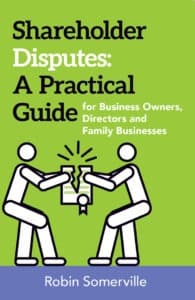
My book The Shareholder Disputes Handbook is a practical guide for business owners, directors and shareholders dealing with disputes over company ownership and control. It covers unfair prejudice petitions in detail, including what amounts to unfair prejudice, the available remedies, valuation issues, the role of quasi-partnerships, derivative actions, breach of shareholders’ agreements, and the strategic decisions that arise at every stage of a dispute. It is written to be accessible to non-lawyers while being substantively accurate and practically useful.
Winning at Commercial Mediation is also relevant for parties involved in shareholder disputes who are considering or approaching mediation, covering how to prepare strategically and achieve the best possible outcome.
“I cannot recommend the services of Robin Somerville enough. What seemed like a complicated and daunting legal procedure was made stress-free, and he ensured a conclusion was reached much quicker than I would have thought. Without doubt, the best money I have ever spent.” Stephanie Bryan, Company Director
“…outstanding… beyond reproach… best possible outcome… fully recommend… cannot thank him enough.”
“Your expert legal advice is second to none and your client care is beyond compare.”
“I am heading towards a dispute for sure. Where do you go? Who do you ask? Robin Somerville put me in the picture and gave me options. I am now prepared and pleased that I have Robin with me.” Company director and shareholder, Midlands
An unfair prejudice petition is a claim brought by a shareholder under section 994 of the Companies Act 2006, asking the court to intervene where the company’s affairs are being conducted in a way that unfairly prejudices the interests of some or all shareholders. It is the most commonly used remedy for minority shareholders who are being treated unfairly by those in control of the company. For full detail see How can I claim an unfair prejudice petition?
A derivative action is a claim brought by a shareholder on behalf of the company, typically where directors have breached their duties and caused loss to the company. Unlike an unfair prejudice petition, which asserts the shareholder’s own rights, a derivative action enforces the company’s rights where the board is unwilling or unable to do so. Court permission is required before the claim can proceed. See How do I bring a derivative claim?
Yes. Minority shareholders have significant legal protections under company law. An unfair prejudice petition under section 994 of the Companies Act 2006 is specifically designed to protect minority shareholders from being treated unfairly by the majority. The fact that you hold a minority stake does not mean you are without remedies.
A quasi-partnership is a private company in which the shareholders have a relationship based on mutual trust and confidence, often where they came together as business partners and incorporated their business. In a quasi-partnership, the court applies higher standards of fair dealing and is more willing to find unfair prejudice where one party acts in ways that breach the understandings and expectations on which the relationship was founded. For more detail see What is a quasi-partnership?
The most common remedy is an order requiring the majority to buy out the petitioner’s shares at a fair value, usually without any discount for the minority nature of the holding. The court also has power to regulate the conduct of the company’s affairs, require or prohibit specific actions, and in appropriate cases order the winding up of the company. See What are the remedies for a successful unfair prejudice claim?
Yes. As a direct access barrister, I can be instructed without a solicitor in appropriate cases. This can make specialist advice available earlier and more efficiently. Find out more about how direct access works.
Yes, and it is increasingly important. Many shareholder disputes settle at mediation, achieving negotiated exits, agreed buyout values and commercial solutions that would not be available from a court. Mediation can be faster, cheaper and more flexible than litigation while producing outcomes that address the real commercial and personal issues at stake. See How important is mediation in shareholder disputes?
Time limits apply and acting promptly is important. Delay can affect both the legal merits of a claim and the remedies available. See Do I have to bring proceedings within a certain time? and take advice as early as possible.
If you are involved in a shareholder dispute, whether as a minority shareholder seeking remedies or as a majority shareholder or director facing a claim, early specialist advice can make a significant difference to the outcome.
I act as a direct access barrister in shareholder disputes and can be instructed without a solicitor in appropriate cases. I also act as a commercial mediator and mediation advocate in shareholder dispute mediations.
Call 020 4538 0246, use the contact form below, or book a call directly.
Important disclaimer: This page is provided for general information purposes only and does not constitute legal advice. The content may not be legally accurate for your situation or at all. You must not rely on anything on this page in respect of your legal rights. Before taking or refraining from taking any legal action, you should seek advice from a qualified lawyer. I disclaim any and all liability for any loss, damage or expense howsoever caused by reliance on the contents of this page. If you would like advice on your specific situation, contact me here.
Fixed-Fee Initial Legal Consultation | Shareholder, Partnership and Family Business Disputes | £1,490 + VAT
See Full DetailsLegal advice, strategy & advocacy
Helping businesses resolve disputes
Independent external HR investigations
Want to check my availability? Need some legal or strategic advice? Or a fee proposal?
I am a direct access barrister. You can save time and money by instructing me using the direct or public access scheme. Or go through your solicitor.
Call 020 3909 9727 or use the contact form.