
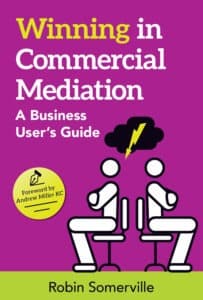
About the Book
Commercial mediation has become a central feature of dispute resolution in England and Wales. Courts increasingly expect parties not only to consider mediation but to engage with it seriously and at an early stage. Following the Court of Appeal’s decision in Churchill v Merthyr Tydfil [2023], courts can now order parties to attempt mediation before proceeding to trial. The costs consequences of unreasonable refusal are real, significant and well-established in the case law.
Yet many business leaders approach mediation without a clear understanding of how the process works, how mediators manage negotiations, how to prepare strategically, or how settlement outcomes are actually reached. This book addresses that gap. It is a comprehensive practical guide to commercial mediation from the perspective of the people who matter most: the business owners, directors, shareholders and executives who have to make real decisions about risk, cost, reputation and commercial relationships during the process.
The book explains how mediation differs from litigation, how mediators work, how to prepare strategically, how to approach the negotiation on the day, how to read the dynamics of the mediation and manage them to best effect, and how to secure the best possible outcome. It also covers what to do after settlement: implementing the agreement, managing compliance, and rebuilding commercial relationships where that is the goal. The book uses the Whitcombe Family Business Dispute as a running case study throughout, illustrating how each concept applies in a realistic multi-party dispute with multiple stakeholders and conflicting interests.
What Professionals Say
“This is a treasure trove of a guide filled with genuine insight, distilled experience and a deep knowledge of how mediation works in commercial disputes. It will help directors and shareholders engage with the process skilfully and successfully.” Phillip Howell-Richardson, Legal 500 Hall of Fame, Chambers UK Band 1, Distinguished Fellow of the International Academy of Mediators, Lexology Index Global Elite
“I would recommend this book to any business owner contemplating mediation. It explains how to approach the process in a way that protects enterprise value while managing litigation risk.” Paul Johnson, Legal 500 Hall of Fame ranked commercial mediator
“Every business owner, CEO, director and shareholder should read this guide and have it sitting on their desk at arm’s reach. It’s a clear step by step approach that demystifies the mediation process and explains how and when to use it to add value rather than cost in times of crisis.” Jane Gunn, International commercial mediator and author of the highly regarded leadership parable The Mole and The Mountain
“Robin Somerville’s Winning in Commercial Mediation should be compulsory reading for all business owners and their advisers facing the lottery that is litigation. Here he explains simply and comprehensively why mediation is a better way to resolve business disputes. I thoroughly recommend it.” Andrew Goodman, Distinguished Fellow of the International Academy of Mediators and author of Effective Mediation Advocacy
Who This Book Is For
This book is written for business owners, company directors and shareholders involved in commercial disputes, for partners in professional firms dealing with partnership or client disputes, for commercial managers and executives responsible for making decisions about litigation and settlement, and for legal advisers who want a comprehensive practical reference for the mediation process from the client’s perspective. It is relevant to anyone involved in a commercial dispute where mediation is being considered or has been proposed, including shareholder disputes, property disputes, construction disputes and professional negligence claims.
What the Book Covers
The book covers the complete commercial mediation process from first consideration through to post-settlement implementation. It explains what commercial mediation is and how it differs from litigation, arbitration and other forms of dispute resolution. It addresses whether and when to agree to mediation, the strategic and commercial reasons to mediate early, and the costs consequences of unreasonable refusal. It covers how to understand the mediation day in detail, including the structure of joint sessions and private caucuses and what the mediator is doing during each stage.
A substantial part of the book is devoted to strategic preparation: how to analyse your BATNA and WATNA, how to identify your zone of possible agreement, how to plan your opening position, how to manage concessions and offers, and how to read and respond to pressure tactics and negotiation dynamics. The book also covers the psychological dimension of mediation in depth, including confirmation bias, overconfidence, loss aversion, anchoring, reactive devaluation and other cognitive biases that consistently cause parties to make worse decisions than they should. Understanding and actively managing these biases is one of the most consistent predictors of better mediation outcomes. The book concludes with 50 top tips for getting the best outcome, 20 of the most common and damaging mistakes to avoid, and a guide to the 20 most important decided cases about commercial mediation.
Contents Overview
The guide covers what commercial mediation is and how it differs from other processes, why to agree or not agree to mediation, whether mediation will save time, money and stress, understanding the mediation process, how confidentiality and the without prejudice rule operate, whether and when it may be appropriate to refuse mediation and the consequences of doing so, how to choose the right mediator, the legal and procedural rules including authority to settle and enforceability of settlement, how the mediation day works in practice, how to prepare strategically including BATNA, WATNA and ZOPA analysis, how to secure the best possible outcome, how to negotiate and draft a legally binding settlement agreement, what to consider after mediation, what unconscious biases are at play and how to manage them, 50 top tips for commercial mediation, 20 top mistakes to avoid, further reading on negotiation and mediation theory, and 20 of the most important cases about commercial mediation.
About the Author
Robin Somerville is a practising barrister, CEDR-accredited commercial mediator and mediation advocate with over twenty-five years of experience across more than a thousand cases. He has acted as mediator in commercial disputes of all kinds and as mediation advocate representing parties at mediation conducted by other mediators. Before qualifying, he founded, grew and sold three technology businesses, one of which ended in a shareholder dispute that settled at mediation. That direct experience as a business owner in a commercial dispute informs the way the book is written throughout. For more detail on Robin’s mediation services see his commercial mediator page and his mediation advocate page.
Related Knowledge Resources
The book is accompanied by an extensive free knowledge hub on this website. The Commercial Mediation Knowledge Hub covers all the main topics from the book in individual chapters, including what commercial mediation is, why to agree to it, confidentiality and the without prejudice rule, the legal and procedural framework, how mediation works in practice, strategic preparation, securing the best outcome, settlement agreements, the 20 most important cases, 50 top tips, the top books on mediation and negotiation, and whether there is a specific mediation privilege in English law. Related knowledge hubs include the Mediation Advocacy Knowledge Hub and the Workplace and Employment Mediation Knowledge Guide.
Frequently Asked Questions
Is this book suitable for someone with no previous experience of mediation?
Yes. The book is designed for business users, not for lawyers or mediation specialists. It assumes no prior knowledge of mediation and explains every concept clearly before building on it. Readers who have never attended a commercial mediation will find it a complete introduction as well as a practical preparation guide.
Does the book address the legal rules around mediation, including the consequences of refusing?
Yes. The book covers the legal and procedural framework in detail, including the courts’ strong expectations around mediation, the costs consequences of unreasonable refusal, how the without prejudice rule operates, the enforceability of mediation clauses in commercial contracts, and the 20 most important decided cases on commercial mediation. The legal chapter is written in plain English and is fully accessible to non-lawyers.
Does the book help with negotiation strategy as well as understanding the process?
Yes. Strategic preparation and negotiation are central to the book. Several chapters are devoted to BATNA analysis, offer and concession strategy, managing pressure tactics, reading the dynamics of the mediation day, and using the mediator effectively as a strategic resource. The book also addresses the cognitive biases that distort judgment in mediation and how to manage them actively.
Is the book relevant to shareholder disputes specifically?
Yes. The Whitcombe Family Business Dispute case study that runs throughout the book is set in a shareholder and family business context, applying the mediation principles party by party to show how the same dynamics look different from each seat at the table. The book is also fully relevant to any other type of commercial dispute.
Does the book address what to do after mediation, whether it settled or not?
Yes. The final sections cover implementing settlement terms, monitoring compliance, managing internal communication about the outcome, conducting a post-mediation review, preventing recurrence, and rebuilding commercial relationships. It also addresses what to do when mediation does not settle, including next steps and the tactical implications for subsequent proceedings.
Purchase
Price: £49.99
Bulk purchase enquiries are welcome for law firms, professional advisers and organisations preparing teams for mediation. Please contact Robin directly to discuss.
Other Books by Robin Somerville
- Shareholder Disputes: A Practical Guide for Business Owners, Directors and Family Businesses
- The Workplace and Corporate Investigator’s Handbook
- Winning in the Witness Box
Get in Touch
If you need a commercial mediator or mediation advocate, Robin would be glad to discuss your situation.
Call 020 4538 0246, use the contact form below, or book a call directly.
Important disclaimer: This page is provided for general information and educational purposes only and does not constitute legal advice. The content may not be legally accurate for your specific situation. You must not rely on anything on this page in respect of your legal rights. The law in this area relates to England and Wales only. Always seek independent legal advice from a qualified specialist before taking or refraining from taking any action. The author accepts no responsibility for any decisions made or outcomes arising from use of this material. If you would like specific advice on your situation, contact Robin here.