
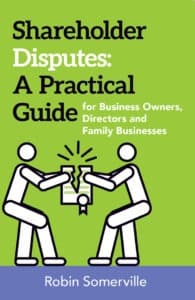
About the Book
Shareholder disputes are among the most disruptive events a business can face. They arise in companies of every size, from small businesses with two founders to large family companies, joint ventures and investor-backed businesses. When relationships between shareholders break down, the consequences can be severe: costly litigation, damage to the value of the business, and in some cases the destruction of companies that were commercially viable and professionally managed.
This book explains the legal framework governing shareholder disputes in England and Wales in clear, practical language. It is written for business owners, directors and shareholders who need to understand their rights and options, not for lawyers. It covers how disputes arise, what the law provides, what litigation involves in practice, how courts approach these cases, and how disputes can be resolved without the full costs and risks of contested proceedings.
The book uses the Whitcombe Family Business Dispute as a running case study, illustrating how the legal principles apply in a realistic multi-party dispute involving a family hotel business, multiple shareholders with conflicting interests, and allegations of serious misconduct. The case study brings the legal analysis to life and makes it possible to see how the same set of facts engages multiple legal routes, defences and remedies simultaneously.
What Professionals Say
“A clear, practical and highly readable guide to one of the most complex and emotionally charged areas of company law. Essential reading for anyone involved in a shareholder dispute, particularly if they want to preserve value and relationships.” Alex Kennedy, Solicitor Advocate, Gannons Solicitors
Who This Book Is For
This book is written for business owners and company directors who are involved in or concerned about a shareholder dispute, shareholders in private companies who believe they are being treated unfairly or who have received a petition against them, family businesses navigating the breakdown of the relationships that underpin the company, entrepreneurs involved in joint ventures where the relationship has deteriorated, and professional advisers including solicitors, accountants and corporate finance advisers who support business owners through shareholder disputes.
What the Book Covers
The book is structured around the main legal routes available in shareholder disputes under English law. It covers unfair prejudice petitions under Section 994 of the Companies Act 2006, including what amounts to prejudice, what amounts to unfairness, the concept of quasi-partnerships and legitimate expectations, the full range of remedies available to a successful petitioner, and how to defend a petition. It covers derivative claims under Section 260 of the Companies Act 2006, just and equitable winding up under the Insolvency Act 1986, breach of shareholders’ agreement claims, and the range of personal claims that may be available to shareholders. It addresses the costs and risks of shareholder litigation frankly, including how costs orders work and what litigation looks like in practice. And it covers the role of mediation in resolving shareholder disputes, including the courts’ strong expectation that parties will engage with mediation before and during proceedings. Throughout, each legal principle is applied to the Whitcombe Family Business Dispute, showing how the analysis changes depending on which family member’s perspective is being considered and what outcome they are pursuing.
Contents Overview
The book covers unfair prejudice petitions and what conduct amounts to unfair prejudice under Section 994 of the Companies Act 2006, breach of shareholders’ agreements and how claims are brought, derivative claims and when shareholders may bring proceedings on behalf of the company, just and equitable winding up and when a court may order a company to close, other potential shareholder claims, the financial and practical realities of shareholder litigation, the role of mediation in resolving disputes, illustrative case examples showing how courts approach these disputes, and a practical checklist for assessing whether bringing a claim may be appropriate.
Why Shareholder Disputes Are So Challenging
Unlike many commercial disputes, shareholder conflicts often involve both legal and personal issues simultaneously. In family businesses and companies that operate as quasi-partnerships, disputes frequently arise when expectations about participation in management, profit distribution, decision-making power or long-term strategy break down. The courts focus not just on strict legal rights but on whether the conduct of the company’s affairs has been commercially unfair to the shareholders affected. Understanding how the law approaches these situations is essential for anyone involved in such disputes.
About the Author
Robin Somerville is a practising barrister and CEDR-accredited mediator specialising in shareholder, director and business disputes. Before qualifying as a barrister and mediator, he founded, grew and sold three technology businesses, one of which ended in a shareholder dispute that settled at mediation. He therefore brings both legal expertise and direct commercial experience to the analysis. He has been involved in well over a thousand cases over more than twenty-five years, as adviser, advocate, mediator and decision-maker. His investigation reports are quality assured by a Crown Court judge. He accepts instructions directly under the direct access scheme, meaning clients can instruct him without going through a solicitor. For more detail see his direct access barrister page and his commercial mediator page.
Related Knowledge Resources
The book is accompanied by an extensive free knowledge guide on this website. The Shareholder Disputes Knowledge Guide covers all the main topics in depth, with individual chapters on unfair prejudice petitions, what amounts to prejudice, what amounts to unfair, quasi-partnerships, remedies, time limits, defending a petition, derivative claims, just and equitable winding up, breach of shareholders’ agreement, costs and risks, the role of mediation, and detailed analyses of recent decided cases. Related guides include the Family Business Disputes Knowledge Hub, the Business Partnership Disputes Knowledge Hub, and the Commercial Mediation Knowledge Hub.
Frequently Asked Questions
Is this book suitable for someone with no legal background?
Yes. The book is written specifically for business owners, directors and shareholders rather than for lawyers. It explains the relevant legal concepts in plain English, using the Whitcombe Family Business case study to illustrate how the law applies in practice. Readers with no legal training will be able to follow the analysis and use it to make more informed decisions about their position.
Does the book cover both bringing and defending a shareholder dispute claim?
Yes. The book addresses both perspectives throughout. The analysis of unfair prejudice petitions covers the grounds for bringing a petition and the defences available to respondents, including the O’Neill v Phillips offer to purchase at fair value. The Whitcombe case study is structured so the reader can see how the analysis differs depending on which family member’s position is being considered.
Does the book cover family business disputes specifically?
Yes. Family businesses are a primary focus throughout. The Whitcombe case study is drawn from a family company context, and the analysis addresses the specific features that make family business shareholder disputes distinctive, including quasi-partnership characteristics, informal governance, and the interaction between personal relationships and legal rights.
How does the book treat mediation?
Mediation is addressed as both a standalone topic and as a thread running through the analysis of litigation risks and costs. The book explains the courts’ strong expectation that parties will genuinely consider mediation before and during proceedings, the costs consequences of unreasonable refusal, and why mediation often produces better outcomes for shareholders than contested litigation.
Can I instruct Robin directly without going through a solicitor?
Yes. Robin accepts instructions from clients directly under the Bar’s direct access scheme. For more detail see the direct access barrister page.
Purchase
Price: £49.99
Bulk purchase enquiries are welcome for law firms, accountants, corporate advisers and business owners purchasing for multiple readers. Please contact Robin directly to discuss.
Other Books by Robin Somerville
- Winning at Commercial Mediation: A Business User’s Guide
- The Workplace and Corporate Investigator’s Handbook
- Winning in the Witness Box
Get in Touch
If you are involved in a shareholder dispute and need legal advice, representation or mediation, Robin would be glad to discuss your situation.
Call 020 4538 0246, use the contact form below, or book a call directly.
Important disclaimer: This page is provided for general information and educational purposes only and does not constitute legal advice. The content may not be legally accurate for your specific situation. You must not rely on anything on this page in respect of your legal rights. The law in this area relates to companies registered in England and Wales only. Always seek independent legal advice from a qualified specialist before taking or refraining from taking any action. The author accepts no responsibility for any decisions made or outcomes arising from use of this material. If you would like specific advice on your situation, contact Robin here.