
Winning in Workplace and Employment Mediation
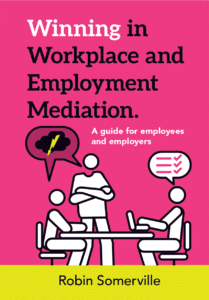
A Guide for Employees, Employers and Their Advisers
A practical guide to resolving workplace and employment disputes through mediation, written for the people inside the dispute and the advisers sitting alongside them. The book covers when to mediate, when not to, how to choose the right mediator, and how to prepare so the day actually delivers a settlement that holds.
Written by Robin Somerville, practising barrister, accredited commercial and workplace mediator, accredited workplace investigator and fee-paid judge, with experience of more than 1,000 contested cases across mediation, investigation, litigation and tribunal proceedings.
About the Book
Workplace and employment disputes are usually treated as two stages of the same problem: a workplace grievance that fails, escalates into a tribunal claim, and is eventually settled at the door of the court. By that point, both sides have spent significant money, the relationship has collapsed, and the outcome is rarely better than what was available six months earlier.
This book is about getting that decision right earlier. It draws a clear line between workplace mediation (designed to keep an employment relationship working) and employment mediation (designed to end one cleanly, usually through a settlement agreement). It explains when each is appropriate, when neither is, and how the same dispute can move between the two depending on the outcome of an investigation, a grievance, or a tribunal claim.
The Meadowbrook Care Home case study runs through every chapter, following three characters through three different processes simultaneously. Each character represents a recurring pattern: the staff member who has lost trust in the organisation, the manager who has been investigated and may face dismissal, and the senior leader caught between regulatory exposure and an internal complaint. By the end, the reader has seen how decisions about mediation made early in the dispute reshape every subsequent option.
The book is grounded in the legal framework that governs these processes. It covers the ACAS Code, the without prejudice rule, section 111A of the Employment Rights Act 1996, the civil litigation authorities (Halsey, PGF II and Churchill), and the consequences of refusing to mediate. It explains the rules in plain language, with worked examples drawn from real cases, anonymised.
Who This Book Is For
This guide is written for:
- Employees and managers involved in workplace conflict
- Employers and HR teams handling grievances, disciplinary processes and tribunal claims
- In-house legal counsel managing employment risk
- Solicitors and barristers acting as mediation advocates
- Workplace mediators and employment mediators
- Trade union representatives
- Organisations building internal mediation capability
It is suitable both for first-time participants and for experienced practitioners who want a structured framework for the decisions mediation requires.
What You Will Learn
The book explains:
- the difference between workplace and employment mediation and when each applies
- when mediation is the right choice, and when it is not (bullying, harassment, discrimination, whistleblowing)
- how to assess your BATNA, WATNA, MLATNA and ZOPA before agreeing to mediate
- how to choose the right mediator and what style of mediation will suit the dispute
- how to prepare on the day, what to expect, and how to handle the difficult moments
- the legal framework around confidentiality, without prejudice and section 111A
- how settlement agreements work and how to negotiate the exit
- how to build a mediation-ready organisation that reduces dispute cost over time
- the cognitive biases that distort mediation outcomes and how to manage your own
Contents Overview
The guide is structured in eight parts that follow the decision-making sequence from first noticing a conflict to building a mediation-ready organisation.
Part I: The Landscape of Workplace Conflict and Mediation. Why workplace disputes escalate, the five stages of conflict, what mediation is and is not, the distinction between workplace and employment mediation, and how mediation differs from investigation, grievance and tribunal processes.
Part II: The Decision: Whether and When to Mediate. The case for mediation, when it is most likely to work, when it is not appropriate, the consequences of refusing to mediate, and a framework for deciding. Mediation in high-risk contexts including bullying, harassment, discrimination and whistleblowing.
Part III: Preparation. How to choose the right mediator, the styles of mediation (facilitative, evaluative, transformative, mixed), preparing your position and understanding the other side’s, BATNA analysis, and the documents and materials you will need.
Part IV: The Mediation Process and Negotiation. What to expect on the day, the role of the precaucus, joint sessions versus private sessions, online and remote mediation, managing behaviour and dynamics in the room, the eighteen unconscious biases that distort mediation, and the structure of opening positions and movement.
Part V: Workplace Mediation in Detail. What workplace mediation is designed to do, when it is used, the role of the workplace mediation agreement, team and group mediation, and returning to work after mediation.
Part VI: Employment Mediation in Detail. What employment mediation is designed to do, the legal framework, settlement agreements, negotiating the exit, the role of legal advisers, and preparing for employment mediation.
Part VII: The Legal Framework. Confidentiality, the without prejudice rule, section 111A of the Employment Rights Act 1996, exceptions to without prejudice protection, and what to do when mediation does not settle.
Part VIII: Practical Guides for Employees, Employers and Organisations. Building a mediation-ready organisation, conflict cultures, the post-mediation review, and the long-term effectiveness of mediated agreements.
Why Workplace and Employment Mediation Matters
The costs of unresolved workplace conflict are well documented. ACAS estimates that workplace conflict costs UK employers around £30 billion a year, before any tribunal claim is filed. A single contested unfair dismissal claim runs to £15,000 to £40,000 in legal fees before any award. Most of those cases settle before trial, and most of those settlements would have been available much earlier through mediation.
The barrier is rarely the cost. The barrier is the timing decision: when to bring in a mediator, when to wait, and how to handle the relationship between mediation and the investigation or tribunal process running alongside it. Get that decision right and the dispute is resolved early. Get it wrong and the same dispute will settle eventually, but only after several months and several thousand pounds more.
This book is, in large part, about making that decision well.
Purchase the Book
Price: £49.99
Bulk purchase enquiries welcome for:
- law firms and chambers building team libraries
- HR teams running internal mediation programmes
- training providers
- universities and business schools teaching mediation
- trade unions and employee representative bodies
Workplace and Employment Mediation Services
Robin Somerville also accepts instructions as a workplace and employment mediator. Mediation services include single-issue workplace mediations, complex multi-party team mediations, employment mediations leading to settlement agreements, and pre-tribunal mediations on referral from solicitors or directly from employees and employers.
For mediation enquiries, see the workplace and employment mediation service page or request a quote.
Related Books and Training
- Winning in Commercial Mediation: the companion volume for commercial and contractual disputes
- The Workplace and Corporate Investigator’s Handbook: where mediation is not the right answer and an investigation is, this is the practitioner’s guide
- Winning in the Witness Box: for cases that proceed to tribunal hearing
- Workplace investigation training: the training course for HR and legal teams handling investigations